
Higher Studies After Engineering
The question is not only whether you can get a loan. It is whether you can repay it.
Many families begin planning higher studies by asking how much they can borrow. The better question is how much the course will cost over its length, how much can be met without borrowing, and what repayments would look like on a realistic salary. This session sets out the main sources of funding and the questions to put to a lender.
Explore this page6 sections
A loan makes a course affordable today and a burden for years.
An education loan can make a good course possible. It can also turn a poor decision into a long one. Families often learn the terms, such as the interest, the repayment start and what is needed as security, after the decision has already been made.
The session is about knowing those terms first. It does not recommend any lender, and it does not say whether to borrow. It says what to ask and how to work out what is safe.
What the session covers
35 topics across 7 areas. Seven parts of paying for a course.
Adding Up What Is NeededBefore asking how to pay.5
- Total fees for the whole programme, not for one year
- Living costs, books and equipment, travel and insurance
- Application and test fees
- A margin for delays, a changed exchange rate and unexpected costs
- The income given up while studying
Savings and Family ContributionsThe part that carries no interest.4
- What the family can contribute without hardship
- Whether any savings are meant for other needs, such as a sibling's education
- Whether your own savings from work could cover part of it
- A shared figure everyone has agreed, before applying
A clear conversation now prevents arguments later.
Scholarships and FellowshipsValuable, competitive and often uncertain.5
Do not count on a scholarship that has not been awarded in writing. Plan the finances so that the course remains possible if it does not arrive.
- Government and institute scholarships in India, each with its own eligibility
- Assistantships and stipends for postgraduate students at some institutes, including for GATE-qualified MTech students
- University-funded scholarships and waivers abroad, usually decided with the offer
- Research fellowships for PhD students, from national schemes and from institutes
- Scholarships from foundations and employers, with their own conditions
Education Loans in India and AbroadA product with terms, not a favour.5
- Banks offer education loans for study in India and abroad under their own schemes
- The Vidya Lakshmi portal, run by the government with the banks' association, lets students apply to several banks through one form
- Collateral and guarantor requirements differ by bank and by loan size, so ask each one
- A government scheme, PM-Vidyalaxmi, offers collateral-free loans with a partial guarantee and some interest support for eligible students admitted to top-ranked institutions in India, within its conditions
- That scheme covers institutions in India, and not courses abroad
Check the current terms on the bank's own site and on the official scheme portals.
What to Ask a Bank, in WritingCompare offers on the same terms.6
- The interest rate, whether it is fixed or floating, and when it can change
- Processing and other fees
- What the loan covers: tuition, living costs, or both
- When repayment starts, and whether interest accrues during study
- The rules for prepayment and for a delay in finding work
- What happens to the loan if you do not complete the course
Working Out RepaymentTest the plan against a modest salary.5
A chartered accountant can tell you how the current tax rules, including those on sending money abroad for study, apply to your family.
- Estimate the monthly instalment for the loan amount and term
- Set it against a realistic starting salary in the country where you will work
- Allow for rent, tax and living costs, and see what is left
- Ask whether you could repay it if you earned less than hoped
- Remember that some tax benefits on loan interest depend on the tax regime you choose
Warning SignsWhen to stop and ask again.5
- A lender or agent who pushes a loan before a course is chosen
- A fee demanded in advance to arrange a loan
- Pressure to sign today, or to hand over documents without copies
- A promise that a job will repay the loan
- Informal or unregulated lenders offering quick money for study
A genuine bank explains its terms in writing and lets you take them home.
A worksheet students take away
- A funding plan: needed, from savings, from scholarships, from a loan
- A repayment estimate to fill in with a bank's figures
- A list of questions for any lender, to be answered in writing
- A short script for the conversation with family
What this session does not do
- Recommend a bank, lender or loan product
- Give personal financial advice
- Promise a scholarship or that a loan will be sanctioned
- Encourage borrowing, or discourage it
How the session runs
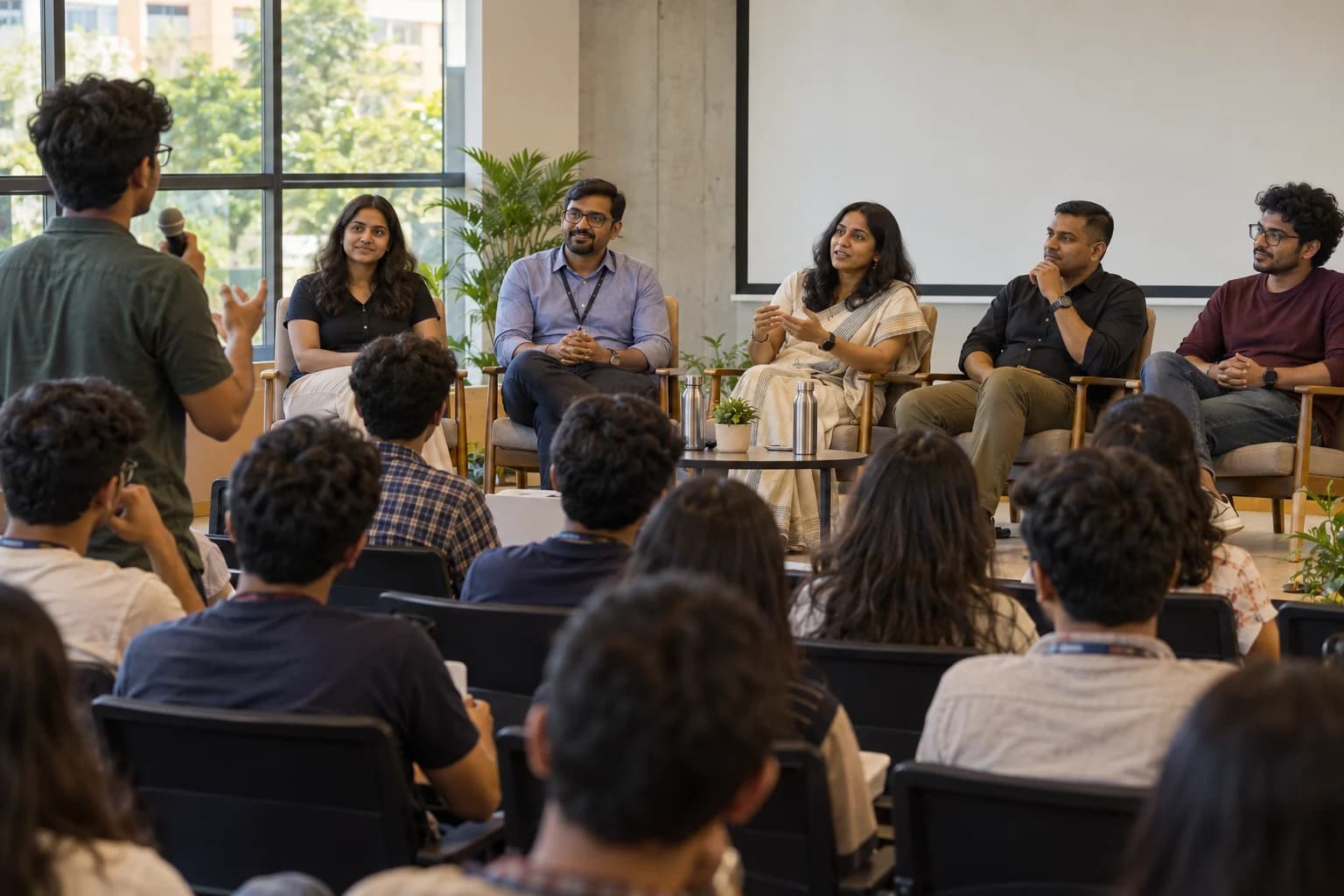
A facilitator explains the sources of funding and the questions above, and people who funded their own higher studies, through savings, scholarships, assistantships or a loan, describe what they did and what they would do differently. A person from the banking or finance field may join to explain how loan terms are read, on the understanding that they do not represent or recommend any lender. Students work through a simple repayment calculation. This session explains the questions to ask and is not financial advice.
What your students leave with
- The main sources of funding, and how certain each one is
- How an education loan works, from application to repayment
- What a repayment really looks like on a realistic salary
- What to ask a bank in writing before signing
- Warning signs of a poor lender or a poor offer
- A plan for the family conversation, whatever the decision
Scheduled sessions
Nothing scheduled yet
Sessions are arranged with a college once a date is agreed. Ask us and we will find the right person for it.
A student rather than a college? See what is coming up, or ask your placement team to host this.
Know what you will repay before you borrow.
Tell us who your students are and what stage they are at. Sessions are free for participants.