
Higher Studies After Engineering
Most students see two or three routes. There are more than that.
By the final year, the choice after engineering has usually narrowed to whatever friends, seniors and coaching centres talk about. This session widens it again. It lays out every route side by side, what each one asks of you in time, money and effort, and what it keeps open or closes, so that a student can then go deeper into the two or three that fit.
Explore this page6 sections
The route most talked about is not always the route that fits.
Students tend to hear about routes in proportion to how loudly they are promoted. A coaching centre speaks about GATE, a consultancy about a country, a relative about an MBA. Quieter routes, such as research, a first job in a core field, or a few years of work before any degree, are mentioned less, and so are chosen less often.
A map does not tell a student what to choose. It makes sure the choice is made with the whole picture in view, and that nobody is picking a route only because it was the first one they heard of.
Working first is on the map as a route in its own right, not as the thing you do if everything else fails.
What the map shows
38 topics across 7 areas. Seven views of the same decision.
The Routes ThemselvesNamed plainly, with no ranking.7
- An MTech or ME in India, often through GATE
- A master's abroad, usually an MS
- An MBA or PGDM, now or after work
- Research: a research master's or a PhD
- A public-sector job, including through GATE or other exams
- A private-sector job, in core engineering, software or elsewhere
- Starting something of your own
Several of these can be combined or sequenced. They are not all mutually exclusive.
What Each Asks of YouTime, money and preparation, compared like for like.6
- Months of preparation before applying
- Entrance exams or tests involved
- Years spent studying
- Fees and living costs, and how they are usually met
- Income given up while studying
- Effort needed after the degree to find work
What Each Keeps OpenSome choices are easy to reverse. Others are not.5
A route that can be started at any point costs very little to postpone. A route with a one-year window needs a decision now, or a deliberate decision to let it go.
- Which routes can still be taken after two or three years of work
- Which have a deadline, such as score validity or an age or batch condition
- Which depend on grades you already have
- Which depend on a loan that has to be repaid whatever happens next
- Which make a change of field easier, and which make it harder
Reasons That Hold UpA good reason survives a second question.5
- I want to do deeper technical or research work, and the job I want asks for it
- I want to move into management, and I have worked out why a degree helps
- I want to change field, and a course is the clearest way in
- I have a particular career in mind and know what it requires
- I want to work first, save, and learn what I like
Reasons That Are Only DefaultsThey sound like reasons and are not.5
- Everyone in my group is doing it
- My family expects it, and I have not discussed alternatives
- I do not have an offer, so I will study for now
- I am not sure what I want, and a degree buys time
- Someone told me this route is the best, without asking about me
Some of these are still fine reasons to study. They are worth saying out loud, so the cost is chosen knowingly.
Working First as a RouteNot a gap, and not a failure.5
- Earning, and learning what work is actually like
- Finding out whether a master's or MBA is wanted or only assumed
- Building the work experience that some programmes prefer
- Keeping several later routes open
- What it costs: momentum, and the effort of returning to study
Questions to Take AwayBetter than any single recommendation.5
- What would I want to be doing day to day in five years?
- Which route gets me closer, and which only feels safer?
- What does it cost in total, and who pays?
- What if it does not work out? What is Plan B?
- Who can I ask who took this route a few years ago?
What students leave with
- A one-page map of the routes, to keep
- A short worksheet comparing two or three routes on the same questions
- A list of what to check on official sites for each route
- A sense of which deadlines, if any, are coming up
What this session does not do
- Recommend a route to any individual student
- Represent a coaching institute, consultancy or university
- Promise admissions, scholarships or jobs
- Treat further study as better than working
How the session runs
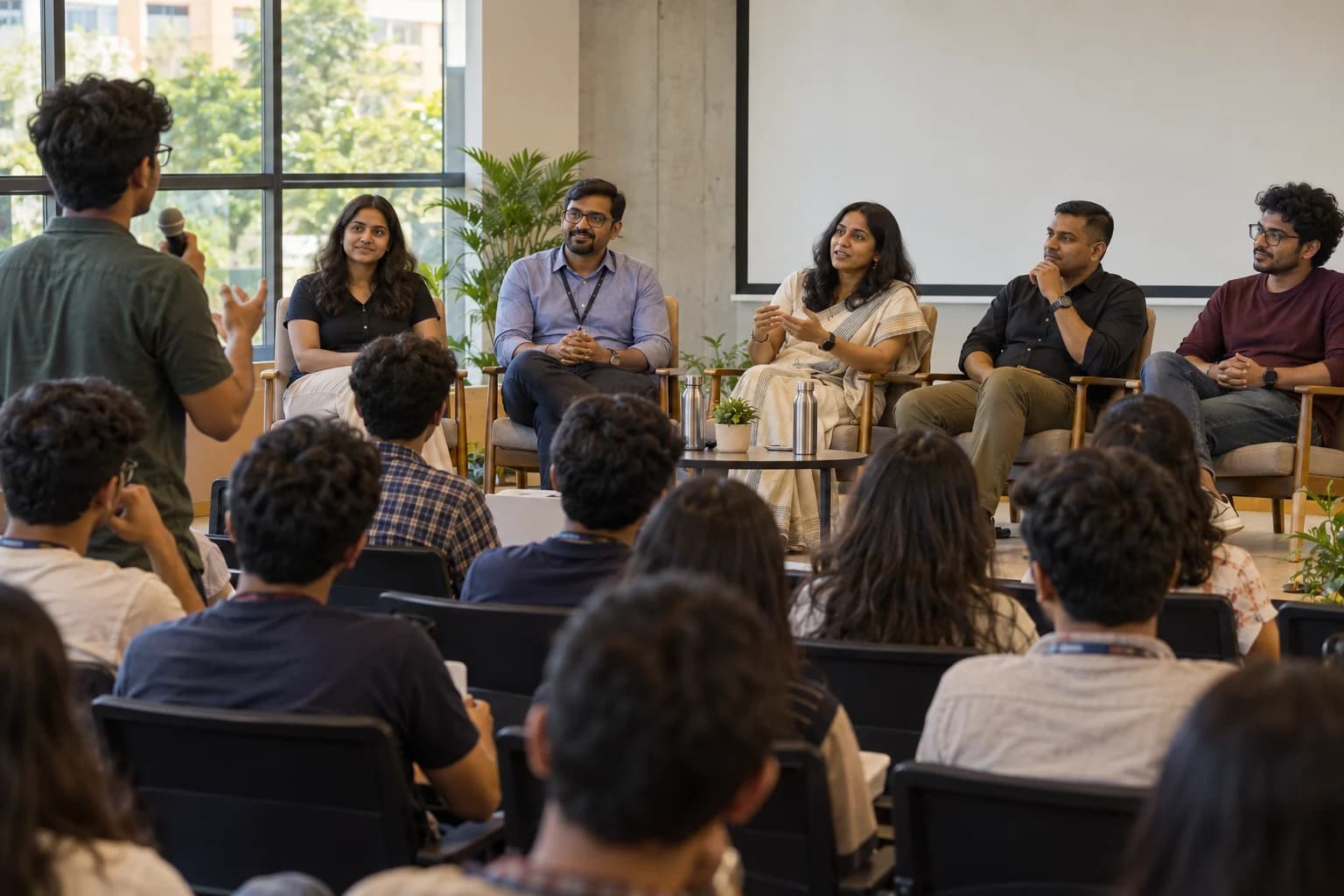
A facilitator presents the map, followed by short accounts from people who took different routes after engineering: what they chose, what it involved and what they would tell a student now. Students then fill in a short worksheet comparing the routes they are considering, and the session closes with questions. Speakers describe their own experience and agree not to promote any service. We agree with the college in advance which routes are worth covering for its students, rather than promising particular speakers.
What your students leave with
- A single picture of the routes open after a BE or BTech
- What each route asks of you in years, money and preparation
- What each route keeps open and what it makes harder to undo
- The difference between choosing a route and drifting into one
- A short list of two or three routes worth looking at properly
- The next step for each, and who to ask
Scheduled sessions
Nothing scheduled yet
Sessions are arranged with a college once a date is agreed. Ask us and we will find the right person for it.
A student rather than a college? See what is coming up, or ask your placement team to host this.
See the whole map before choosing a road.
Tell us who your students are and what stage they are at. Sessions are free for participants.