
Higher Studies After Engineering
Many engineers want an MBA. Fewer can say what it is for.
An MBA is a popular next step after engineering, and often a hazy one. This session asks what the degree is for, whether it is best done straight after the BTech or after a few years of work, what the entrance routes involve, and how to weigh a large fee against a career that is not guaranteed to change.
Explore this page6 sections
An MBA is a means. Students often treat it as an end.
For engineers, an MBA can open management, consulting, product, finance and business roles that a technical degree alone does not lead to straight away. It can also be a very expensive way to avoid deciding what you want to do.
The right time for it, if it is right at all, depends on what you want from it. Someone who wants to move into a business role within two or three years has a different case from someone who wants a particular company's management trainee scheme, or a founder who wants to learn finance. A good session separates these cases.
What the session covers
35 topics across 7 areas. Seven questions to answer before sitting an MBA entrance. 6 apply to almost any business; the rest only in a particular case.
What an MBA Is ForFour honest reasons, and some weaker ones.5
- Moving from a technical role into management or business
- Changing industry or function, such as into finance or consulting
- Building a network and a credential in a new field
- Learning business skills for running or joining a company
- Weaker reasons: following friends, delaying a decision, or a vague wish for a higher salary
An MBA gives access and skills. It does not give a job or a promotion on its own.
Straight After EngineeringThe case for going now.5
- You are used to studying, and the habit is fresh
- Fewer financial and family commitments
- Some programmes in India admit students with little or no work experience
- A longer career afterwards over which to use the degree
- The risks: less to contribute to class discussion, less idea of what you want to do afterwards, and less weight in some admissions processes
After a Few Years of WorkThe case for waiting.5
Read each programme's own admission policy for how it treats experience. Do not rely on what a coaching centre says about it.
- You know the work you want to leave, and the work you want to move to
- Many programmes give weight to work experience, though how much differs by institute and by year
- Classroom discussion draws on real experience, and recruiters notice it
- Savings, or an employer's support, may reduce the borrowing needed
- The risks: it gets harder to leave a good salary, and to return to study
Entrance RoutesA short orientation. The exams themselves have their own session.5
- CAT, which the IIMs use for their flagship programmes, and which many other institutes accept
- Other national and institute-level tests, such as XAT, NMAT and CMAT, each with its own list of accepting programmes
- GMAT or GRE, accepted by some Indian and many overseas programmes
- Group discussion, written ability and personal interview rounds after the test
- Each score is valid only for a limited period, so timing matters
Check the eligibility rules and the current format on each exam's official website.
Cost and ReturnDo the sum for your own case.5
Placement figures are averages across a cohort, and averages hide the spread. Ask for the median, the range and the proportion of the batch included in the figure.
- Total fees and living costs for the programme
- The salary you give up if you leave a job to study
- What the programme itself reports about graduate roles and pay, and how it measures that
- How long repayment of a loan would take on a realistic post-MBA salary
- What you would do if the placement outcome is below the average
Alternatives to a Full MBAIf it appliesSometimes the goal can be reached more cheaply.5
- Moving into a business role inside your current company
- A specialist master's in finance, analytics or management
- Short and part-time programmes while working
- Employer-sponsored study
- Learning on the job, with a mentor
Choosing a ProgrammeFit before prestige.5
- What the curriculum and the electives cover
- Where graduates of the programme actually work
- Whether a programme's reputation holds in the field you want to enter
- How faculty, peers and alumni would help you in that field
- Speaking to two recent graduates, and not only to admissions staff
Questions students leave with
- What do I want to be doing three years after an MBA?
- Could I get there without one, or with a shorter programme?
- What does it cost me in total, including lost income?
- What would I want to have done by the time I apply?
- Who has made this move that I could ask?
What this session does not do
- Rank business schools
- Represent a coaching centre or an institute
- Promise a score, a seat or a placement
- Treat an MBA as the right next step for every engineer
How the session runs
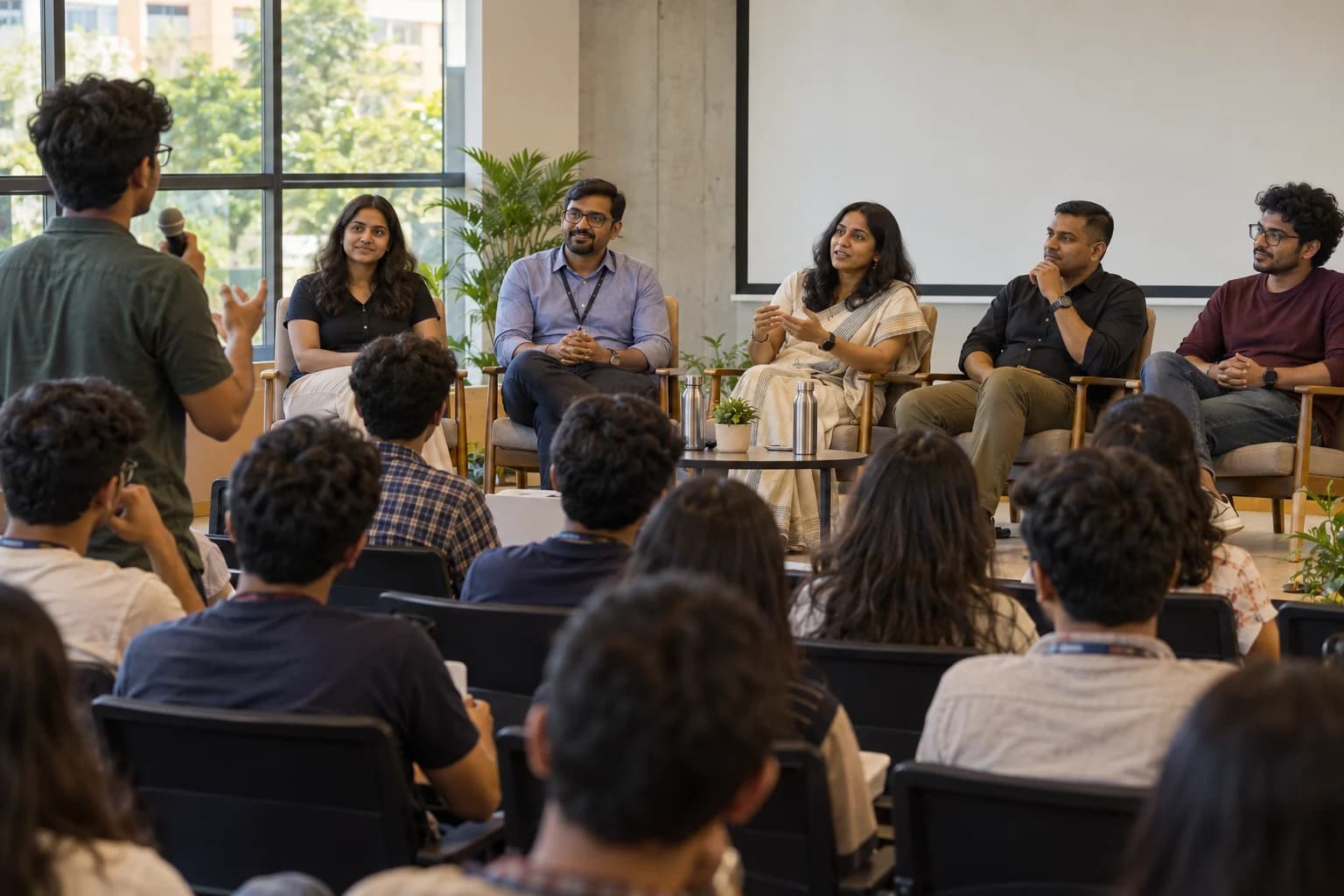
A facilitator presents the questions above, followed by short accounts from engineers who did an MBA straight after the BTech, who did it after working, and who decided not to do one. Each speaker says what it cost, what it changed and what they would do differently. Students then work through a comparison of going now and going later for their own situation. No institute or coaching centre is represented, and speakers agree not to promote any service.
What your students leave with
- A clear idea of what an MBA does and does not do
- The arguments for going straight away and for waiting, side by side
- How the main entrance routes work, at a high level
- How to compare programmes on outcomes and cost, not only on reputation
- Alternatives to a full MBA that may serve the same goal
- A way to decide that you can explain to your family
Scheduled sessions
Nothing scheduled yet
Sessions are arranged with a college once a date is agreed. Ask us and we will find the right person for it.
A student rather than a college? See what is coming up, or ask your placement team to host this.
Decide what the MBA is for, then decide when.
Tell us who your students are and what stage they are at. Sessions are free for participants.