
Higher Studies After Engineering
A PhD is not a longer master's. It is a different kind of work.
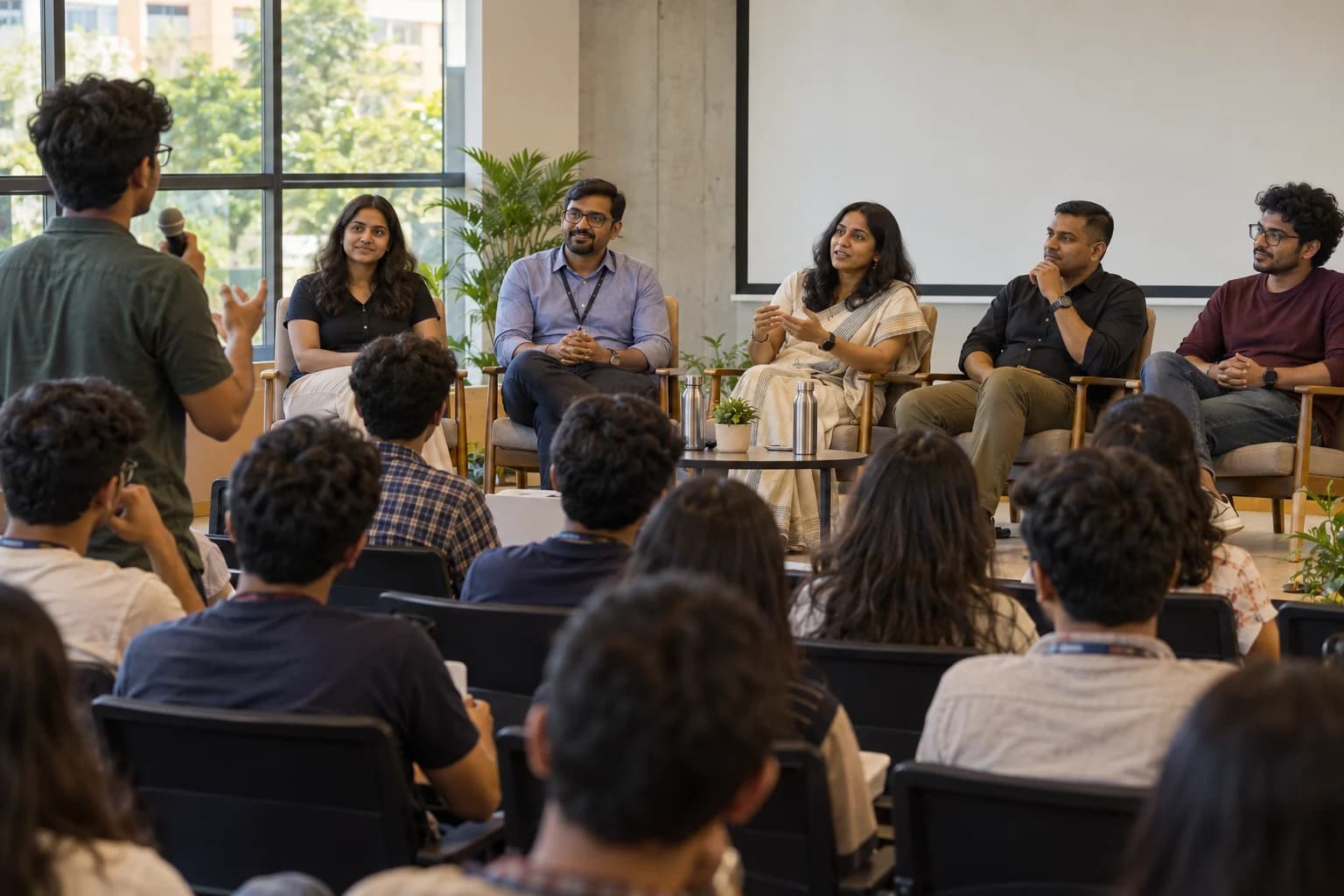
Students who enjoyed a final-year project often wonder about research, and are told either that a PhD is the highest achievement or that it is a waste of years. Neither is helpful. In this session people who did a PhD, and people who tried research and chose differently, describe the work, the funding, the uncertainty and what it led to.
Explore this page6 sections
Research is a good fit for some people and a poor one for others.
A PhD is a commitment of several years in which the main product is a piece of original work, not a grade. Progress is uneven, results often do not come, and much of the work is done alone. Some people find that deeply satisfying, and others find it wearing.
Students rarely get to hear about this from the inside. The session gives them accounts from people who did it, including the unglamorous parts, so the decision rests on more than a lab visit or a supervisor's pitch.
What the session covers
35 topics across 7 areas. Seven parts, from daily work to the years afterwards. 6 apply to almost any business; the rest only in a particular case.
What Research Is LikeWeek to week, not just at graduation.5
- Reading papers and working out what is not yet known
- Long stretches of work that does not produce a result
- Writing, and rewriting, as a normal part of the job
- Presenting to people who will question it
- Depending on one supervisor's time, interest and funding
Who It Tends to SuitTendencies, not rules.5
- People who like a problem for its own sake, and can stay with it
- People comfortable with uncertainty and slow progress
- People who can work independently, and ask for help when needed
- People who enjoy reading, writing and explaining
- Not necessarily the highest scorers: curiosity and persistence matter
Plenty of people with top marks find research frustrating, and plenty with average marks find it right.
Entering a PhD in IndiaIn outline. Check each institute.5
National fellowship schemes publish their stipend, eligibility and application windows on their official sites. Check them directly, since both amounts and conditions are revised.
- Admission usually involves a written test or interview at the institute, and an eligibility score such as GATE or a national research-fellowship exam
- Research fellowships and stipends exist, some tied to a national exam, and each has its own rules
- Some schemes target students from certain institutes or with high scores
- Part-time or sponsored routes exist for people who are working
- Each institute's own admission page is the authority
Entering a PhD AbroadIf it appliesDifferent from an MS.5
- Admission usually depends on a supervisor or department wanting you
- Many research programmes offer funding, though not all, so read what each says
- Research experience, a strong project and good recommendations matter more than in many master's applications
- Test requirements vary, and some programmes no longer require the GRE
- Visa and post-study work rules still apply, as for any student
Choosing a SupervisorThe decision that shapes the whole PhD.5
- How much time they give their students
- What their former students did afterwards
- Whether their group is well funded
- How they work: closely guiding, or leaving students to find their way
- Talking to current students, away from the supervisor
A good supervisor on a less fashionable topic is usually a better bet than the reverse.
After a PhDSeveral outcomes, and none of them certain.5
- Academic posts, which are competitive and often begin with short research contracts
- Industrial research and development roles, in some fields
- Technical and leadership roles in companies that value deep expertise
- Starting a company based on the research
- Moving into a field unrelated to the research, with the skills it built
Testing the Interest FirstCheaper than a wrong five years.5
- Doing a serious final-year project and writing it up
- Working as a research assistant or intern in a lab, in India or abroad
- A research master's, before committing to a doctorate
- Reading recent papers in an area and trying to follow them
- Asking a PhD student what a bad month looks like
Questions for a potential supervisor
- How is your group funded, and for how long?
- How often do you meet your students?
- What did your last three graduates do?
- How long does a PhD with you usually take?
- What would you expect of me in the first year?
Questions students ask themselves
- Would I enjoy the work if nobody ever praised it?
- Can I live on the stipend, and for how long?
- What would I do if I decided in the third year that I wanted to leave?
- Is there another way to do work like this?
How the session runs
Two or three people who did a PhD, in India or abroad, and, where possible, someone who started and left or chose not to begin, each describe the work, the funding, the hard patches and what came after. Students then ask questions and work through the questions above. Speakers describe their own experience, are not recruiting for any lab or university, and agree not to promote any service. We agree with the college in advance which fields to cover.
What your students leave with
- What research work is like week to week, not only at the end
- A realistic idea of who tends to enjoy it and who does not
- How a PhD is funded and entered, in India and abroad, in outline
- What the years after a PhD may look like, including outside academia
- A low-cost way to test your interest before committing
- Questions to ask a potential supervisor
Scheduled sessions
Nothing scheduled yet
Sessions are arranged with a college once a date is agreed. Ask us and we will find the right person for it.
A student rather than a college? See what is coming up, or ask your placement team to host this.
Try the work before you sign up for the years.
Tell us who your students are and what stage they are at. Sessions are free for participants.