
Higher Studies After Engineering
Nobody knows what AI will do to your career. That is no reason to guess.
Students are told that AI will take entry-level engineering jobs, so they should study more. Others are told that degrees no longer matter. Both claims are made confidently and neither can be known today. This session does not pretend to settle it. It offers better questions to ask, about skills, about the programmes on offer and about what a master's can and cannot protect you from.
Explore this page6 sections
Fear is a poor reason to spend two years and a loan.
Almost every claim about AI and jobs is a forecast, made by someone with a view. Some people have reason to say it will change everything, others to say it will change little. What is known is that tools are changing quickly, that some tasks in engineering work are being done differently, and that employers are still working out what they need from new graduates.
A student deciding on a master's has to act under that uncertainty. The session offers a way to do that: by asking what you can find out, what you can change if you are wrong, and what a degree actually provides.
What the session covers
33 topics across 7 areas. Seven questions to ask instead of predicting. 6 apply to almost any business; the rest only in a particular case.
Reading the HeadlinesWho is saying it, and what do they gain?5
- Is the claim a forecast, a survey or a measurement?
- Who commissioned it, and who sells something related to it?
- How large was the sample, and what kind of work was counted?
- Does it describe tasks, or whole jobs?
- Is the source a company, a researcher or an individual with a view?
Be as careful with a claim that agrees with you as with one that does not.
What Can Be Known NowA smaller list than the debate suggests.4
None of this predicts five years ahead. It does tell you what is happening now, which is a better basis than a headline.
- Which tools are in everyday use in the field you are interested in
- What current job postings for new graduates ask for
- What people who graduated recently say about their first year
- What your target employers say about how they use these tools
What a Master's Can AddThings that tend to last, whatever the tools do.5
- Depth in a subject, and the ability to reason about it from first principles
- Training in research methods, if the programme includes them
- Time and supervision to build something substantial
- A credential some employers and some countries still ask for
- A network, and a structured way to change field
What a Master's Cannot DoBe equally clear.4
- Guarantee a job, or protect a role from being redefined
- Replace practical experience of working with real systems and tools
- Make a weak programme current by itself
- Justify a high cost if the plan to repay it rests on one assumption
Testing a ProgrammeIs it teaching what is happening now?5
- Whether the syllabus is updated, and when it was last revised
- Whether projects use current tools and real data
- Whether faculty publish or work in the area
- Where recent graduates work, and what they say about the course
- Whether an equivalent course exists for less, or can be done while working
Building Skills Without Waiting for a DegreeIf it appliesOpen to everyone, and a good test.5
- Building projects with the tools used in your field and writing about them
- Contributing to open-source work or a shared project
- Taking short, structured courses and applying them to a real problem
- Learning to check and correct the output of tools, not only to use them
- Showing the work in a portfolio an employer can look at
A Decision That Can ChangePrefer reversible to certain.5
- Would a job now, and a master's later, keep the option open?
- Is there a cheaper or shorter route to the same skills?
- Will the cost still be sensible if the market is weaker than hoped?
- What would make you change your mind, and when will you check?
- Who in the field can you ask each year as things develop?
What students leave with
- A short set of questions for testing any claim about AI and jobs
- A checklist for judging whether a programme teaches current practice
- A list of ways to build and show skills while working
- A reminder to review the plan on a fixed date, not only when worried
What this session does not do
- Predict which jobs will disappear
- Say that a master's is essential, or a waste
- Recommend an AI course, a tool or a company
- Give career advice to an individual student
How the session runs
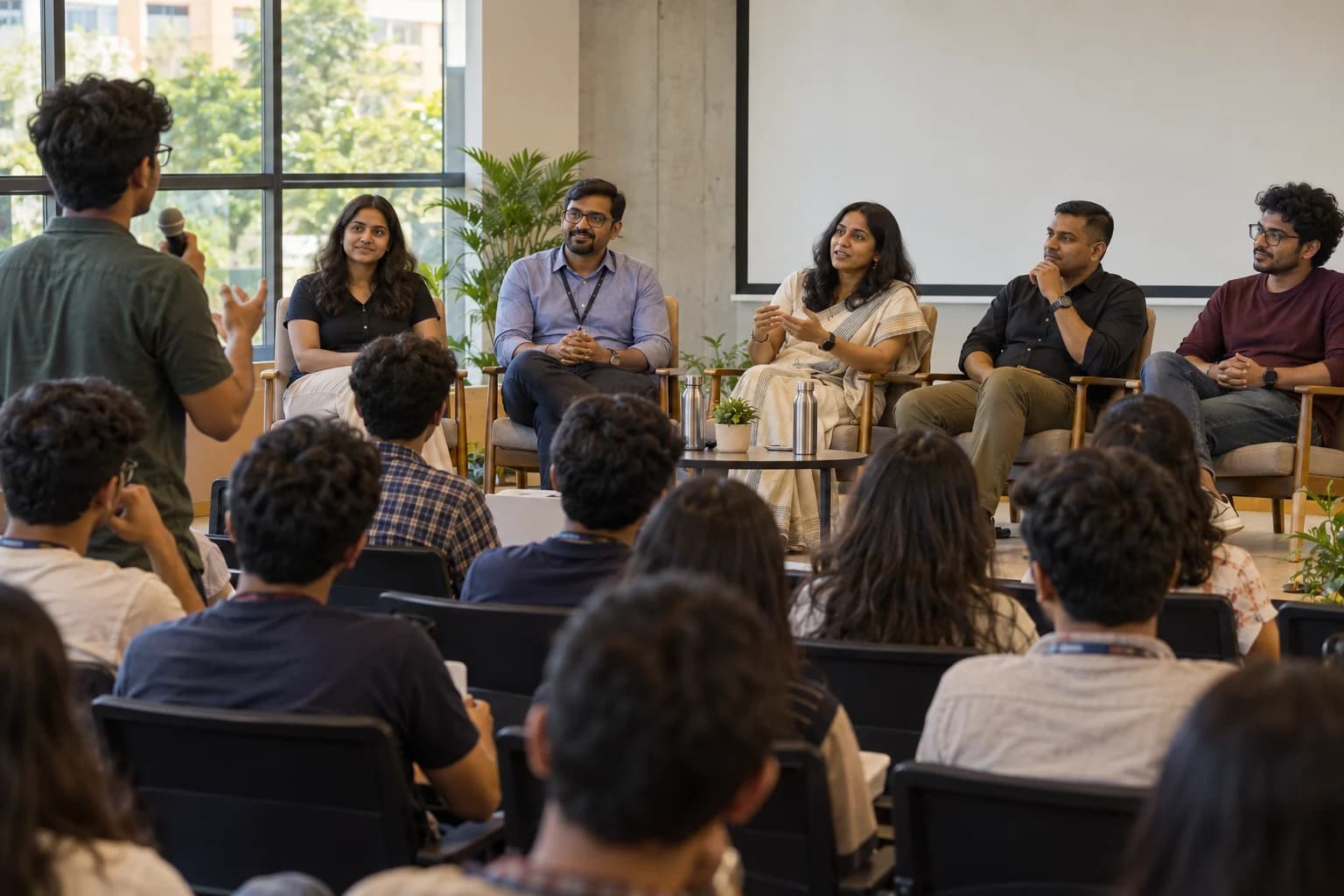
A facilitator sets out the questions above, and two or three people who work with these tools in engineering, and who have studied further or chosen not to, describe what they actually see at work and what they think a degree adds or does not. Speakers are asked to separate what they have observed from what they expect. Students then test a headline of their own against the questions. No company or course provider is represented, and speakers agree not to promote any service.
What your students leave with
- Why confident predictions on this subject deserve caution
- Questions that are more useful than predictions
- What a master's can add that is likely to last, and what it cannot
- How to tell whether a programme actually teaches current practice
- Ways to build and show skills without a degree
- A decision that can be changed as the picture becomes clearer
Scheduled sessions
Nothing scheduled yet
Sessions are arranged with a college once a date is agreed. Ask us and we will find the right person for it.
A student rather than a college? See what is coming up, or ask your placement team to host this.
Ask better questions than the headlines do.
Tell us who your students are and what stage they are at. Sessions are free for participants.