
Entrepreneurs on Campus
Students can hear about running a business for years and never make one decision
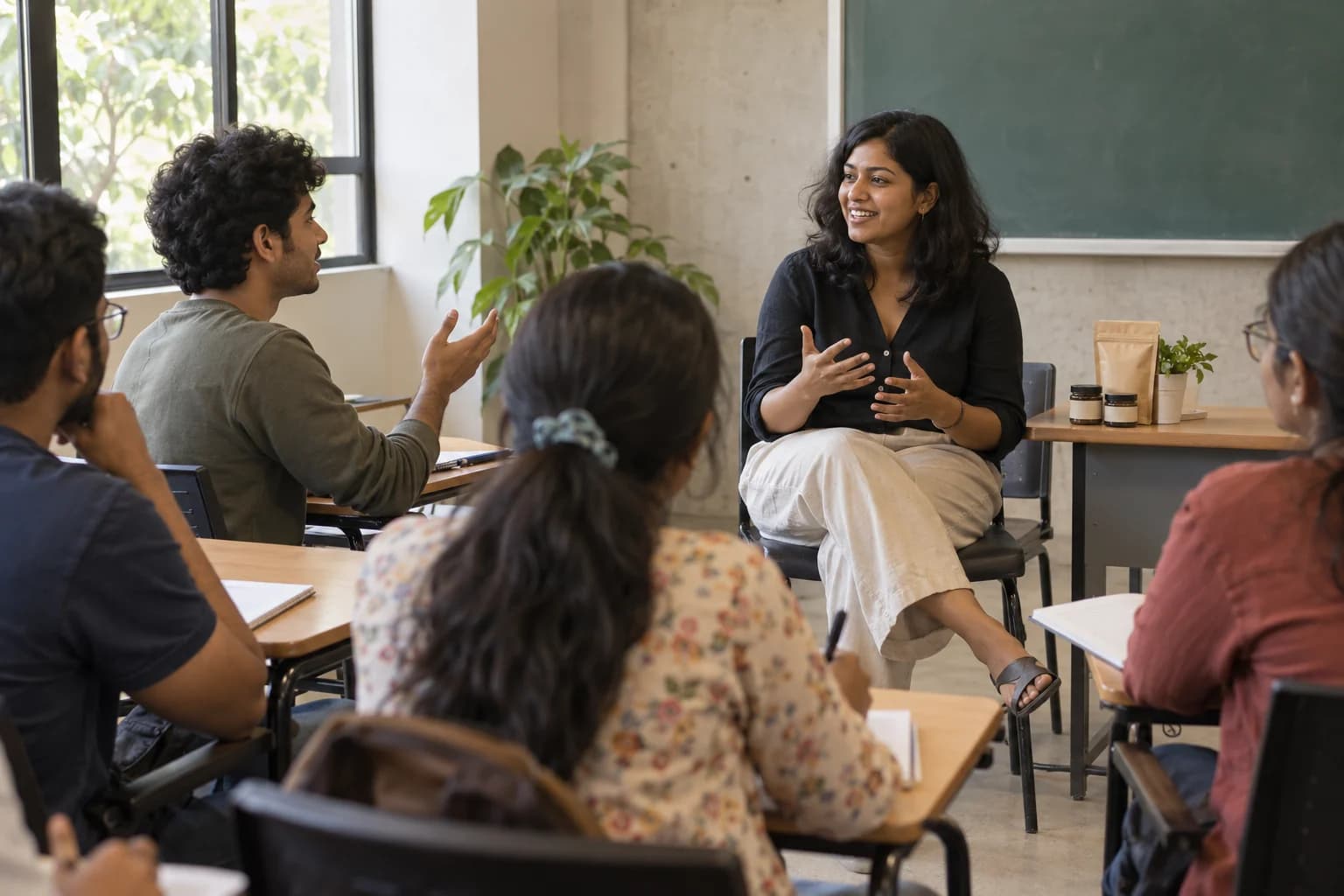
Talks describe a business from outside. A business is a long run of small choices made with half the information: a customer who wants a lower price, a supplier who is late, a job to offer or refuse. In this session students are given a made-up day of such choices, decide in small groups, and then hear a visiting founder explain how they would think about each one.
Explore this page6 sections
Entrepreneurship is usually presented as an idea. Most of it is decisions.
A student who has only heard founders speak on a stage may think the hard part is the idea. In practice a great deal of the work is deciding, again and again, with no one to hand the decision to. Whether to give a discount, whether to wait for a payment, whether to say yes to a large order you can barely deliver.
Reading about those decisions is not the same as making one. A short exercise in a room, with classmates arguing the other way, shows a student how hard even a small decision feels when the business is yours.
This is not a simulation of a real business and it does not predict anything about what a student would face. The situations are written for the session and are made up. Their job is to give the founder something concrete to react to.
How the day is built
27 topics across 7 areas. Seven parts, in the order they happen in the room.
Setting the SceneA small, ordinary business, made up for the session.4
- A short description of an invented business of a kind students will recognise
- What it sells, who buys it, and what a normal week looks like
- How much money there is, described in plain terms rather than as a case study
- The rule for the day: every group has to decide, even without enough information
The business is fictional. It is not a story about any real person or company.
The Morning ProblemsSmall decisions that arrive one after another.5
Groups write a one-line decision and one line of reasoning for each. Nobody is marked.
- A regular customer asks for a lower price on a repeat order
- A supplier says an order will be late by several days
- A customer is happy but has not yet paid
- A helper asks for time off at the busiest point of the week
- A new customer wants something slightly outside what the business does
The Afternoon ProblemsBigger choices, with fewer good answers.4
- Spending on something that would help but cannot be undone
- An offer to take on a larger order that would stretch the team
- Two things that both need the founder's time on the same day
- A complaint that may or may not be fair
What the Founder SaysHow they would think about it, not a model answer.4
- The founder reads each decision and says what they would want to know first
- Where they would lean and what would change their mind
- Which choices were reversible and which were not
- A decision of their own, kept general, where they think they chose badly
Speakers are asked to say 'it depends' where it does depend, and to explain on what.
Where the Groups DisagreedThe most useful minutes of the session.3
- Groups that chose opposite things on the same problem explain why
- What each side was protecting: cash, the relationship, time, reputation
- Which information would have settled it, and how it could be found
What a Founder Cannot Hand OffThe decisions that stay with the owner.4
- Why some decisions cannot be delegated early on
- What changes when there is a team to consult
- Why a business owner often decides tired, late or alone
- How they keep a record of decisions so they can learn from them
Closing QuestionsStudents ask what the day raised.3
- Open questions for the visiting founder
- What students would want to practise before trying this for real
- A final round: one thing each group would do differently
What the founder prepares
- An outline of how they decide: what they ask, what they check, who they consult
- A few real kinds of decision they have faced, described without naming customers
- One decision they would now make differently
- A willingness to say that their way is one way, not the way
What students do
- Work in groups of four to six and write one-line decisions
- Argue for a choice they did not first favour
- Ask the founder what information they would want before deciding
- Say what they found hardest about deciding for someone else's money
How the session runs
The founder and the students share the room for a half-day or a long morning. The scene is set in the first quarter of an hour, groups work through the problems in short rounds, and after each round the founder responds. Written scenarios are prepared for the session and handed out on paper or shown on screen. The visiting founder is briefed on what to cover and agrees in advance that the session is not a pitch: they may explain what they do, but may not sell to the room, recruit from it or ask students to sign up for anything. The length, group size and number of rounds are agreed with the college before the day.
What your students leave with
- A feel for the kind of decisions a business owner makes, and how often
- Practice at deciding with incomplete information and saying why
- An understanding that most business decisions have costs on both sides
- A clearer view of what the founder's own judgement is for
- Seeing how a founder weighs money, people and time in one choice
- Questions students can still put to a founder afterwards
Scheduled sessions
Nothing scheduled yet
Sessions are arranged with a college once a date is agreed. Ask us and we will find the right person for it.
A student rather than a college? See what is coming up, or ask your placement team to host this.
Let students make a few business decisions before they have to make real ones.
Tell us who your students are and what stage they are at. Sessions are free for participants.