
Career Launch
“Preparing for interviews” is not preparation
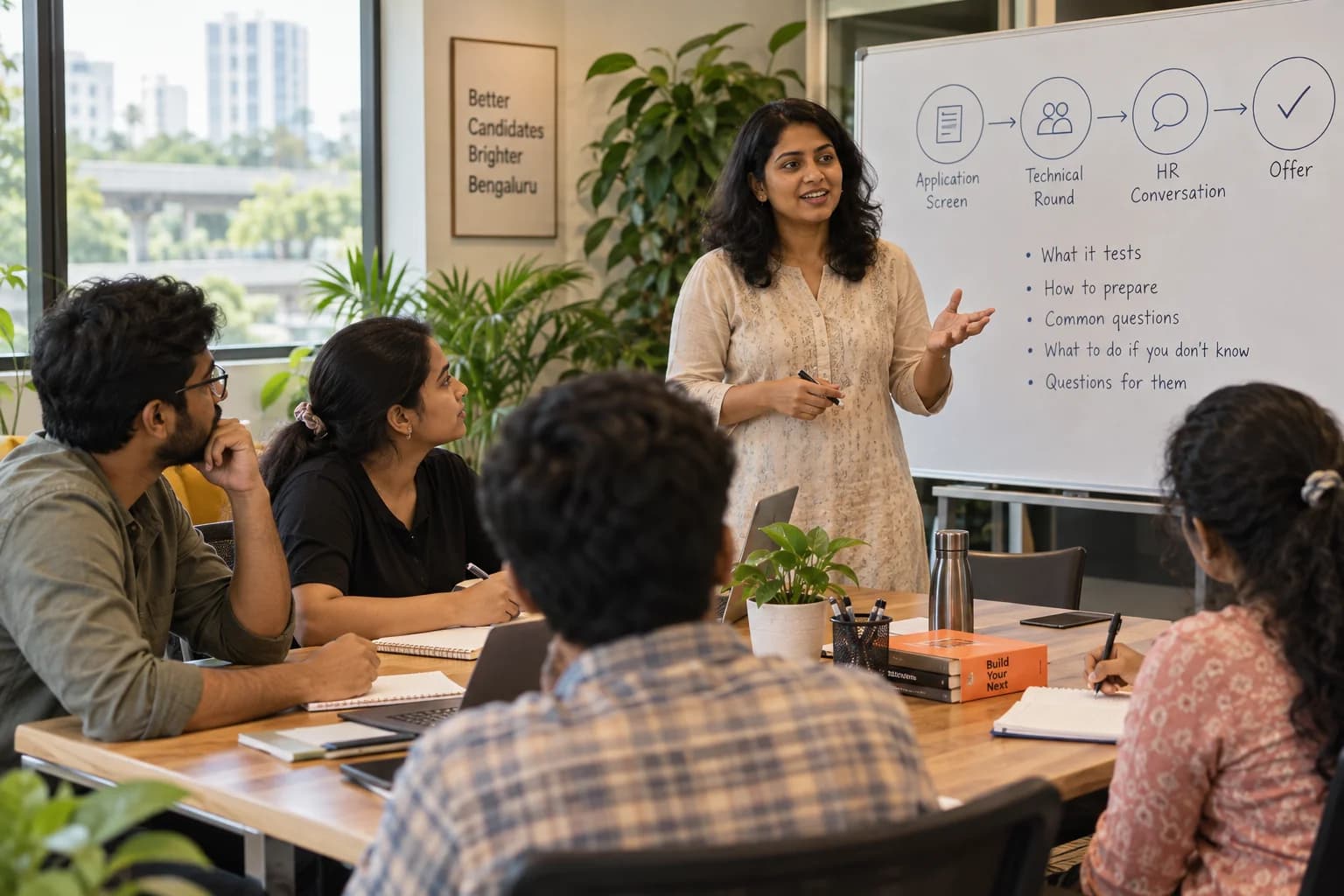
A job seeker preparing for everything is preparing for nothing. This session narrows it to the specific rounds a target role puts you through, what each is testing, and what to do in the moment you do not know.
Explore this page6 sections
Every role interviews differently. Prepare for yours.
An analyst interview, a developer interview and a support interview share almost nothing except the handshake. Generic preparation produces a candidate who is vaguely ready for all of them and convincing in none.
The second thing that separates candidates is what happens at the edge of their knowledge — because every interview finds that edge, and the response to it is usually more informative than the answers before it.
How to prepare
38 topics across 7 areas. Seven parts of a real preparation plan.
Map the Actual ProcessFind out what you are walking into.7 topics
- How many rounds
- Whether an online assessment comes first, and its rules on proctoring and AI tools
- What each round tests
- Who conducts it
- How long it takes
- What the company publishes about it
- What somebody who has been through it says
The Fundamentals for That RoleDepth in a few things, not breadth in everything.4 topics
- What the role assumes you know
- Which of those you are weak in
- What is worth revising in the time you have
- What is not worth revising at all
Your Own Resume, Line by LineThe most predictable source of questions.5 topics
Everything on the document is fair game, and the candidate wrote it. There is no excuse for being surprised by it.
- Every skill listed
- Every project
- Every internship
- Every claim and number
- The gap, if there is one
The Standard QuestionsPredictable, and still answered badly.7 topics
- Tell me about yourself
- Why this role
- Why this company
- Strengths, with evidence
- A weakness, with what you did about it
- Where you see yourself
- Why should we hire you
Behavioural QuestionsAnswered from a small set of real stories.5 topics
Six or seven genuine experiences — a difficulty, a failure, a disagreement, a team, something you learned, something you owned — will answer most of what is asked.
- Situation
- Task
- Action
- Result
- And what you learned
At the Edge of What You KnowThe response that separates candidates.5 topics
“I have not worked with that directly, but based on what I know I would approach it this way” keeps the conversation alive. Silence and bluffing both end it.
- Ask for clarification
- Connect it to something adjacent
- Say how you would find out
- Work it through aloud
- Be honest quickly
Your Questions for ThemAn interview is also information gathering.5 topics
- What would I work on in the first months?
- How is training handled?
- What makes somebody succeed here?
- How is performance judged?
- What are the next steps?
Never ask something the website answers in two minutes.
Common mistakes
- Preparing generally rather than for a specific role
- Memorising answers that collapse under a follow-up
- Not knowing what the company does
- Contradicting your own resume
- Bluffing rather than admitting the limit
- No questions at the end
Preparing on a deadline
- Interview in two days: resume, role research, standard questions, one story per theme
- Interview in two weeks: add fundamentals revision and a mock
- No interview yet: fundamentals, evidence and stories — the durable parts
How the session runs
A practitioner who interviews for the participants' target roles explains what each round is actually testing. The room then builds a preparation plan for one specific role, drafts a story bank from real experience, and practises the edge-of-knowledge moment deliberately, because it is the one nobody rehearses.
What your students leave with
- A preparation plan for one specific role
- Knowledge of what each round is testing
- Their own resume revised to the point of being defensible
- A story bank covering most behavioural questions
- A workable response to questions they cannot answer
- Questions worth asking the interviewer
Scheduled sessions
Nothing scheduled yet
Sessions are arranged with a college once a date is agreed. Ask us and we will find the right person for it.
A student rather than a college? See what is coming up, or ask your placement team to host this.
Start a conversation
Ask for this session
Tell us who you are and what you have in mind. A person reads it and writes back, usually within two working days.
- Tell us what you need
A topic or a question is enough to start.
- A person replies
Usually within two working days.
- Agree the next step
We work out the details together.
Prepare for the interview you will actually sit.
Tell us who your students are and what stage they are at. Sessions are free for participants.