
From Campus to Career
Students commit a final year to a direction they chose by accident
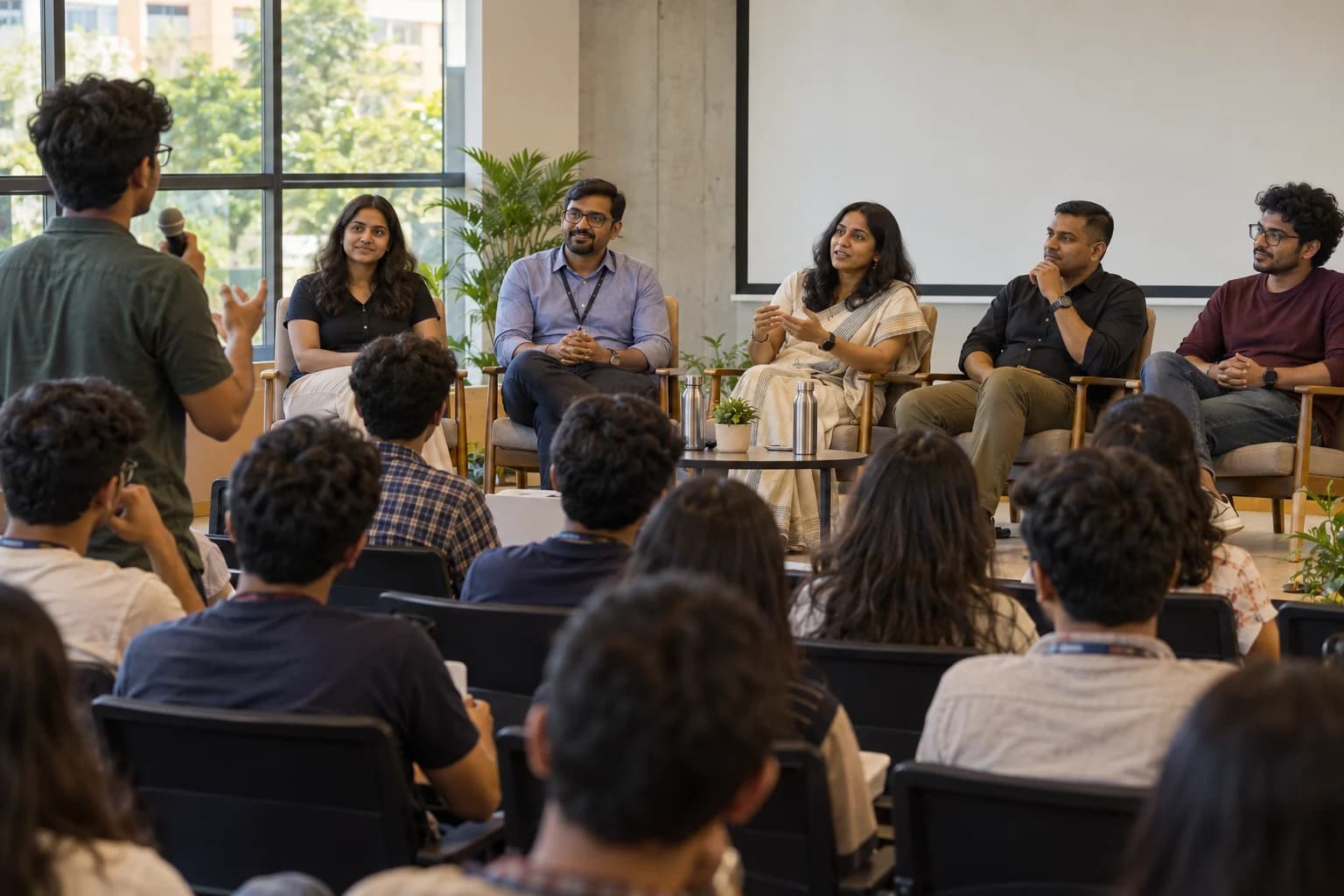
Most start preparing before deciding what they are preparing for — random technologies, unrelated certificates, applications to everything. This session lays out the paths actually open after engineering and puts a practitioner behind each one, so the preparation that follows has a target.
Explore this page8 sections
Students prepare hardest for the career they understand least.
Preparation without direction often produces the same pattern: random technologies, unrelated certifications, applications to every role, comparison by salary alone, and following a friend into work they may not enjoy.
A clearer direction answers the questions that actually govern a final year — what to learn, what to build, which internships to chase, which companies to target, what to prepare for in interviews. No student has to decide a whole career here. They have to make a better next decision.
The market is also wider than the IT-services names most campuses recruit for. In TeamLease EdTech's survey of 1,097 employers for the second half of 2026, intent to hire freshers was highest in retail, e-commerce and technology start-ups (93%), manufacturing (89%) and FMCG (86%), while IT's fell from 81% to 76%. Hiring intent is not a promise of hiring, and it moves from survey to survey — but a plan built on one sector is narrower than the options.
The paths on the table
119 topics across 18 areas. Each one explained by somebody doing the work.
Software DevelopmentBuild applications, platforms and digital products.7 topics
Roles include Software, Backend, Frontend, Full-Stack, Mobile and Platform Engineer. Useful foundations: programming, data structures, databases, software design, problem-solving, version control.
- Websites
- Mobile applications
- Business software
- APIs
- Cloud systems
- Consumer products
- Enterprise platforms
Ask a software engineer: what does a developer actually do after joining a company?
Data AnalyticsTurn data into information a business can act on.6 topics
Analysts help organisations understand what is happening. Useful skills: Excel, SQL, data visualisation, statistics, business understanding, Python.
- Cleaning data
- Analysing trends
- Building dashboards
- Creating reports
- Finding patterns
- Supporting business decisions
Suits students who enjoy numbers, patterns and business questions.
Data Science & Machine LearningBuild systems that learn from data.6 topics
Roles include Data Scientist, Machine Learning Engineer, AI Engineer and Applied Scientist. Needs stronger foundations in programming, mathematics, statistics, machine learning and data handling.
- Predictive models
- Machine learning
- Recommendation systems
- Natural-language processing
- Computer vision
- Data experimentation
Artificial IntelligenceBuild and apply intelligent systems.7 topics
AI careers now extend well beyond traditional machine learning.
- Generative AI
- Large language models
- AI applications
- AI agents
- Automation
- AI-assisted software development
- AI product development
The question is not “should I learn AI?” but “where can AI be applied, and what fundamentals do I need to build something useful?”
Cloud ComputingBuild and manage infrastructure at scale.7 topics
Students will meet AWS, Azure and Google Cloud. Cloud knowledge is increasingly useful across other technical careers too.
- Cloud infrastructure
- Deployment
- Networking
- Storage
- Security
- Scalability
- Monitoring
DevOps & Platform EngineeringHelp software move reliably into production.7 topics
DevOps sits between software development and infrastructure.
- CI/CD
- Cloud infrastructure
- Containers
- Deployment
- Automation
- Monitoring
- Reliability
Suits students who enjoy both software and systems.
CybersecurityProtect systems, networks, applications and information.5 topics
Roles include Security Analyst, Security Engineer, SOC Analyst, Application Security Engineer, Cloud Security Engineer, Penetration Tester and Security Consultant. Needs strong networks, operating systems, Linux, programming and security fundamentals.
- Networks
- Operating systems
- Linux
- Programming
- Security fundamentals
Cybersecurity is a great deal broader than ethical hacking alone.
Software Testing & Quality EngineeringMake sure software works as expected.5 topics
- Manual testing
- Automation testing
- API testing
- Performance testing
- Quality engineering
Modern testing involves real automation and programming. It is an engineering career, not a fallback from development.
Business AnalysisConnect business problems with technology solutions.6 topics
Analysts work between customers, business teams and technology teams.
- Understand requirements
- Analyse problems
- Document processes
- Work with stakeholders
- Translate business needs into system requirements
- Support solution design
Appeals to students who like technology but also communication and understanding how businesses work.
Product ManagementDecide what should be built, and why.5 topics
Product managers work with customers, engineers, designers, business teams, sales and leadership. The combination is technology, business, customer understanding and communication.
- Problems worth solving
- Product priorities
- Features
- User experience
- Business goals
Most people enter product roles after experience in engineering, analytics, design or business.
Technical Sales & SolutionsUse technical knowledge while working directly with customers.6 topics
Roles include Solutions Engineer, Pre-Sales Engineer, Technical Sales Engineer, Solutions Consultant and Customer Engineer.
- Understanding customer problems
- Demonstrating products
- Designing solutions
- Presentations
- Technical discussions
- Supporting sales teams
Suits engineering students who enjoy technology and people in equal measure.
ConsultingSolve business and technology problems for organisations.6 topics
Requires problem-solving, communication, research, presentation and structured thinking.
- Technology transformation
- Business processes
- Digital strategy
- Operations
- Data
- Enterprise systems
Core Engineering CareersYour degree does not have to lead to software.13 topics
- Mechanical design
- Manufacturing
- Automotive
- Electronics
- Embedded systems
- Telecommunications
- Electrical systems
- Construction
- Infrastructure
- Industrial automation
- Robotics
- Renewable energy
- Semiconductors
Students should see both core engineering and technology-led options before deciding.
Campus Placement or Off-Campus?One route, not the only one.6 topics
Campus placement is the visible route because it comes to you. It is not the only source of jobs, and for many roles it is not the best fit — a good deal of hiring happens off-campus and never reaches a placement cell.
- What campus placement actually covers
- Which companies never come to campus
- How off-campus hiring works
- Company career pages and direct applications
- Referrals and professional communities
- Why preparing for both is the safer plan
Not being placed on campus closes one route. Students who know that in advance behave very differently when it happens.
Research & Higher StudiesGo deeper into a field.6 topics
MTech, MS, MSc, research programmes or a PhD. In India, GATE is the national entrance route for many postgraduate programmes and is also used by some public-sector employers — but the GATE organisers themselves state that qualifying does not guarantee admission or a PSU job.
- Specialisation
- Research exposure
- Advanced technical roles
- Academic careers
- International opportunities
- GATE, and what a score does and does not guarantee
The decision should rest on a clear reason, not on avoiding the job market.
MBA & Management CareersMove towards business and management.8 topics
Engineering graduates move into these over time; an MBA is one route among several.
- Marketing
- Finance
- Operations
- Consulting
- Product management
- Strategy
- Business development
- General management
Answer two questions first: why do I want an MBA, and what career am I hoping it builds?
EntrepreneurshipBuild something of your own.7 topics
A good technical idea is not enough on its own — customers, sales, marketing, finance, operations, people and execution all matter.
- Starting a technology company
- Building a product
- Joining a family business
- Freelancing
- Consulting
- Building a small business
- Solving an industry problem
The point is not to push everyone towards starting a company. It is to make entrepreneurship a visible option.
Government & Public SectorEngineering services and public institutions.6 topics
- Engineering services
- Public-sector organisations
- Government technical roles
- Competitive examinations
- Recruitment through GATE scores at some PSUs
- Research organisations
Students should understand the preparation, timescale and competition involved before committing to it.
How a student should choose
- What kind of problems do I enjoy solving — technical, analytical, business, customer-facing, operational?
- What kind of work do I enjoy — building, analysing, talking to people, managing, researching, designing?
- What am I naturally curious about? What I explore voluntarily is a clue.
- What skills am I willing to develop deeply? Interest alone is not enough.
- What does the actual job look like? Ask somebody doing it, not a course description.
Reasons not to choose a path
- “Everyone is learning it” — popular does not mean right for you
- “The salary is high” — compensation matters, so do aptitude and long-term fit
- “My friend chose it” — their strengths are not yours
- “I already completed a course” — a course need not decide a career
- “My branch decides my future” — your degree shapes a starting point, not every decision after it
Who students meet
- Software engineers
- Data professionals
- AI engineers
- Cybersecurity professionals
- Cloud and DevOps engineers
- Product managers
- Business analysts
- Core engineers
- Consultants
- Technical sales professionals
- Entrepreneurs
- Researchers
- Young professionals
Questions students can ask
- What do you actually do every day?
- How did you enter this career?
- What skills matter most?
- What did you misunderstand as a student?
- What does an entry-level person do?
- What is difficult about the role?
- What career growth is possible?
- What should I start doing while I am still in college?
How the session runs
The career landscape first — the major paths available after engineering. Then practitioners explain briefly what their own careers actually involve. The paths are compared on work, skills, entry routes, learning and progression. Open questions follow. Each student finishes by naming one career to explore, one person to speak with, one skill to investigate and one action to take.
What your students leave with
- Greater awareness of the career possibilities that exist
- A better understanding of what different roles actually involve
- Clarity about the skills each path requires
- More realistic expectations of entry-level work
- The questions worth researching further
- A smaller, deliberate set of paths worth exploring
- One practical next step, chosen rather than defaulted into
Scheduled sessions
Nothing scheduled yet
Sessions are arranged with a college once a date is agreed. Ask us and we will find the right person for it.
A student rather than a college? See what is coming up, or ask your placement team to host this.
Start a conversation
Ask for this session
Tell us who you are and what you have in mind. A person reads it and writes back, usually within two working days.
- Tell us what you need
A topic or a question is enough to start.
- A person replies
Usually within two working days.
- Agree the next step
We work out the details together.
You do not need to know where a career ends. You need enough to choose the next direction.
Tell us who your students are and what stage they are at. Sessions are free for participants.